
Which Commercial Convection Oven Should You Buy? A Guide to Turbofan
https://uploads.prod01.sydney.platformos.com/instances/647/assets/modules/homepage/webapp_uploads/blog/images/commercial-bakery-oven-in-action-11795780833585-1795780835098.jpg?updated=1795780840&updated=1795780876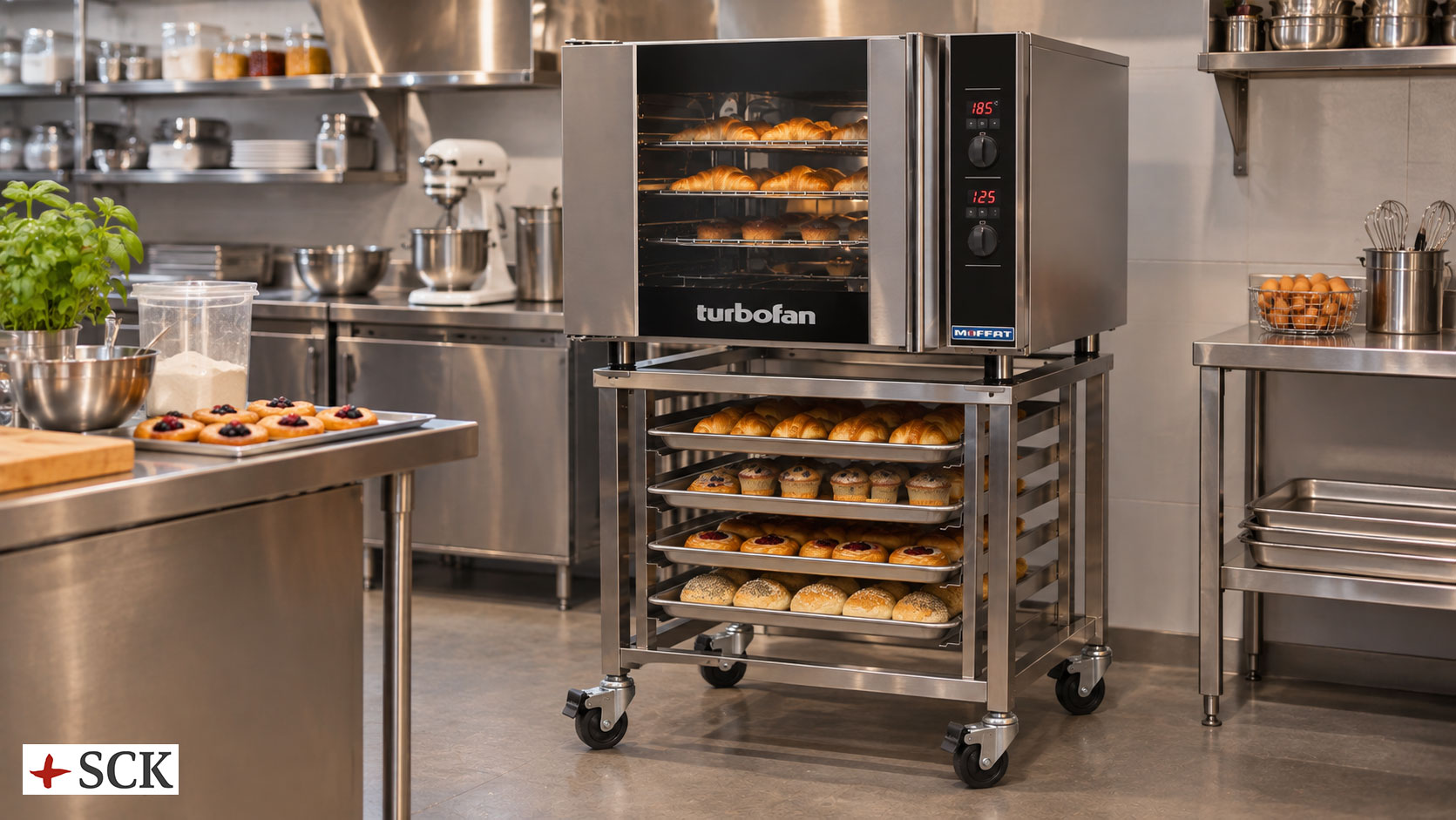
A commercial convection oven is a versatile cooking appliance that uses fan-assisted heat circulation to support consistent baking, roasting, reheating and food preparation. It is particularly suitable for hospitality businesses requiring reliable cooking performance, repeatable results and efficient use of kitchen space.
The Turbofan E31D4 Digital Electric Convection Oven offers four GN 1/1 tray positions, programmable cooking controls, grill functionality and a relatively compact benchtop design. It is well suited to cafés, restaurants, caterers, pubs and smaller commercial kitchens requiring flexibility across multiple menu items.
However, the best commercial convection oven is not necessarily the largest or most technologically advanced model. Choosing the right equipment requires understanding your menu, production volume, tray requirements, available utilities and long-term business objectives.
The Turbofan commercial convection oven range includes several configurations designed to address these different operational requirements.
What is a commercial convection oven and why do professional kitchens use one?
A commercial convection oven circulates heated air around food using an internal fan, helping distribute heat throughout the cooking chamber and supporting more consistent cooking results than traditional static heating alone.
In commercial kitchens, consistency is particularly important because customers expect the same food quality regardless of who prepares their meal or how busy the venue becomes.
Convection cooking can support a wide variety of applications, including pastries, cakes, roasted vegetables, chicken, baked pasta dishes and prepared meals.
The Turbofan E31D4 uses a low-velocity, single-direction fan system. This provides fan-assisted cooking without relying on the higher airflow configurations found in some larger commercial ovens.
Its additional grill mode also extends its usefulness beyond conventional baking.
Consider a café that prepares muffins before opening, roasted vegetables before lunch and baked sandwiches during service. A versatile convection oven allows these different cooking tasks to be completed using one appliance rather than several pieces of specialised equipment.
For businesses with limited kitchen space, this flexibility can be particularly valuable.
Before purchasing, identify the cooking methods that account for most of your menu. A convection oven should complement your actual food preparation requirements rather than duplicate equipment you already own.
Which Turbofan convection oven is suitable for your commercial kitchen?
The most suitable Turbofan convection oven depends on the type of food you prepare, the volume required during peak periods and the electrical or gas infrastructure available at your premises.
Smaller hospitality businesses may benefit from straightforward manual ovens, while larger restaurants, bakeries and production kitchens may require greater tray capacity or more advanced cooking controls.
Turbofan E30M3 Manual Electric Convection Oven
The E30M3 is a practical choice for businesses requiring simple operation and moderate cooking capacity.
It accommodates three GN 1/1 pans with 100 mm tray spacing and has a 2.3 kW electrical rating. Its manual controls make it suitable for kitchens where experienced staff regularly prepare familiar menu items.
Turbofan E31D4 Digital Electric Convection Oven
The E31D4 provides four GN 1/1 tray positions and programmable cooking functionality within the same external cabinet dimensions as the E30M3.
It represents a useful middle ground for businesses requiring additional capacity and greater control over repeatable cooking procedures.
Key specifications include:
- Four GN 1/1 tray positions.
- 80 mm tray spacing.
- Up to 20 programmable cooking settings.
- Digital time and temperature controls.
- Grill mode.
- 3.1 kW electrical rating and 15-amp connection.
- Dimensions: 810 × 616 × 625 mm (H).
- Weight: 68 kg.
Turbofan E32D4 Electric Convection Oven
The E32D4 is worth considering for bakeries and higher-volume food production businesses. Its four 600 × 400 mm bakery tray positions provide a different production format, supported by a 6.5 kW electrical rating.
Turbofan G32D4 Gas Convection Oven
The G32D4 accommodates four 600 × 400 mm trays and has a rated gas consumption of 35 MJ per hour. It may be suitable for commercial premises with existing gas infrastructure.
Turbofan E33D5 Digital Convection Oven
The E33D5 accommodates five GN 1/1 trays within a cabinet measuring 610 mm wide. Its 6 kW electrical rating makes it an option for businesses requiring greater cooking capacity within a narrower equipment footprint.
When comparing these ovens, prioritise operational suitability rather than assuming that a more expensive model will necessarily improve your business.
What can you cook in a Turbofan E31D4 convection oven?
The Turbofan E31D4 can support a broad range of baking, roasting, reheating and finishing applications, making it particularly useful for hospitality businesses with varied menus.
Typical food preparation applications include:
- Muffins, cookies, cakes and pastries.
- Roasted vegetables and suitable meat dishes.
- Frittatas, quiches and baked pasta.
- Prepared meals and savoury bakery products.
- Toasted sandwiches and selected grilled dishes.
Its grill mode provides additional flexibility when food requires surface browning or finishing.
For example, a pub kitchen might use the oven to prepare roasted vegetables before service, bake individual portions of lasagne during quieter periods and finish selected dishes as orders arrive.
A catering business could use the same equipment to prepare consistent batches of savoury pastries and cooked menu components.
However, convection cooking is not ideal for every application. Foods requiring controlled steam, specialised humidity settings or intensive high-temperature cooking may benefit from alternative equipment.
Review your existing menu and proposed future offerings before purchasing. The E31D4 is most valuable when its cooking flexibility can be utilised regularly throughout the working day.
What size commercial convection oven does your business need?
Commercial convection oven capacity should be based on peak production requirements rather than the total number of meals served throughout the day.
A restaurant serving 150 customers may require less oven capacity than a bakery producing hundreds of pastries within a short morning production window.
The E31D4 accommodates four GN 1/1 trays, providing a practical format for kitchens already using standard Gastronorm equipment.
However, tray spacing must also be considered. Its 80 mm spacing may suit relatively shallow products, while taller baked goods or roasting containers may require some tray positions to remain unused.
Consider a café preparing 96 muffins before opening. If each suitable tray accommodates 12 muffins, four trays could theoretically hold 48 muffins per batch. Two batches would therefore be required.
This is an illustrative capacity calculation, not a manufacturer-rated production output. Actual results depend on tray dimensions, muffin size, recipe, airflow and validated cooking settings.
A business producing 240 muffins within the same production window may require additional oven capacity or a different tray configuration.
Calculate capacity using the food you actually prepare, including realistic loading, preheating, unloading and cleaning times. This provides a more accurate assessment than comparing tray numbers alone.
Are digital convection ovens better than manual convection ovens?
Digital convection ovens are generally more suitable when businesses require repeatable cooking procedures across multiple employees and shifts. Manual ovens remain useful for straightforward production environments where experienced staff prefer direct control.
The Turbofan E30M3 uses manual controls, while the E31D4 provides digital cooking settings and storage for up to 20 programmes.
The ability to save established cooking settings can simplify recurring preparation tasks and reduce unnecessary adjustments during operation.
For example, a café employing several kitchen assistants could establish individual programmes for muffins, savoury pastries and selected prepared meals.
Instead of relying on each employee to remember cooking temperatures and durations, staff can follow validated settings established by the head chef or kitchen manager.
This does not eliminate the need for training. Employees must still understand tray loading, food safety, ingredient variations and how to recognise correctly cooked food.
A smaller owner-operated café may find manual controls entirely adequate. A hospitality business employing multiple shifts may receive greater operational value from digital programming.
Choose digital controls when repeatability and simplified procedures are important to your business, rather than simply because digital equipment appears more advanced.
What is the difference between a convection oven and a combi oven?
A convection oven primarily uses circulating dry heat for cooking and baking, while a combi oven combines convection heat with controlled steam and combination cooking modes.
This distinction affects equipment suitability, installation requirements and overall investment.
The Turbofan E31D4 is a practical option for businesses predominantly preparing baked products, roasted foods and meals that do not require sophisticated steam management.
A commercial combi oven may be more suitable for hospitals, aged care facilities and large production kitchens requiring greater control over food moisture across diverse menus.
For example, a hospital preparing hundreds of meals may require steam cooking for vegetables and carefully controlled cooking conditions for specialised dietary requirements.
A café primarily baking pastries and reheating suitable prepared meals may not require this additional functionality.
Selected larger convection oven models offer moisture injection features, but these should not be confused with comprehensive combi steam functionality.
Businesses should compare the cooking methods required by their menu before committing to either equipment category.
If your menu does not require controlled steam, a convection oven may provide the necessary cooking flexibility with a smaller initial investment and less complicated operation.
Does a Turbofan convection oven require three-phase power?
Not every Turbofan convection oven requires three-phase power. Electrical requirements vary according to model, heating capacity and oven configuration.
The Turbofan E31D4 has a 3.1 kW electrical rating and is supplied with a 15-amp plug connection. It operates on a suitable single-phase electrical supply.
By comparison, the E30M3 has a 2.3 kW electrical rating, making it worth considering for businesses with more limited electrical infrastructure.
Larger models such as the E32D4 and E33D5 have substantially higher electrical demands.
This matters particularly when replacing equipment in older commercial premises, shopping centre tenancies or smaller hospitality venues.
For example, a café replacing an existing small countertop oven may discover that its available electrical outlet cannot accommodate the E31D4 without additional electrical work.
Although the equipment itself may fit the available bench space, installation costs could change the overall purchasing decision.
Before ordering, confirm:
- Available electrical circuit capacity.
- Required plug or hardwired connection.
- Existing electrical loads from nearby equipment.
- Any necessary switchboard or circuit upgrades.
A licensed electrician should confirm the suitability of the proposed installation.
The published electrical rating should always be included in your equipment planning rather than treated as an after-purchase consideration.
Are electric or gas commercial convection ovens cheaper to operate?
Neither electric nor gas commercial convection ovens are automatically cheaper to operate. The most economical option depends on local utility tariffs, actual operating time, heat losses, cooking requirements and existing infrastructure.
The E31D4 has a rated electrical input of 3.1 kW. At an illustrative electricity tariff of $0.30 per kWh, continuous operation at maximum rated input would cost approximately $0.93 per hour.
Actual electricity consumption will vary because heating elements do not necessarily operate continuously at maximum input.
The G32D4, by comparison, is rated at 35 MJ per hour. Its operating cost depends on gas tariffs and actual burner operation.
These ovens also have different tray configurations and production capabilities, meaning a direct comparison of hourly energy costs alone may be misleading.
A larger oven that completes production in fewer batches could potentially offer better operational value despite having a higher rated energy input.
Similarly, a smaller oven may be more economical for businesses preparing modest quantities throughout the day.
When comparing equipment, assess total ownership costs, including installation, energy consumption, maintenance, servicing and expected utilisation.
The objective is to select equipment that produces the required volume efficiently, not simply the oven with the lowest electrical rating.
Can a commercial convection oven improve kitchen productivity and reduce labour costs?
A commercial convection oven can support improved kitchen productivity by allowing multiple portions to be prepared simultaneously and helping employees follow consistent cooking procedures.
The Turbofan E31D4 combines four tray positions with programmable cooking settings, which may reduce repetitive adjustments and improve batch organisation.
Consider a restaurant preparing vegetables, baked desserts and selected menu components before evening service.
If the kitchen currently relies on several smaller cooking appliances, consolidating appropriate preparation tasks into scheduled oven batches could reduce unnecessary movement and equipment handling.
For example, saving 15 minutes of repetitive preparation-related activity each day would represent approximately 78 staff hours over 312 trading days.
At an illustrative labour cost of $35 per hour, this represents $2,730 worth of staff time annually.
These figures are illustrative rather than guaranteed labour savings. The business may use the recovered time for other productive kitchen activities rather than reducing staffing expenditure.
Equipment productivity should be measured against your existing workflow.
Review how employees currently prepare food, identify recurring bottlenecks and determine whether a convection oven could help address them before estimating a return on investment.
What installation and ventilation requirements should you consider?
Commercial convection oven installation requires suitable equipment support, ventilation, electrical connections, manufacturer-specified clearances and adequate access for safe operation and servicing.
The E31D4 measures 810 mm wide, 616 mm deep and 625 mm high. Its listed weight of 68 kg means the supporting bench or stand must be suitable for the appliance and its intended loading.
Its side-hinged door also requires adequate opening space without obstructing nearby equipment or staff movement.
Ventilation requirements depend on the appliance, cooking processes, local regulations and overall kitchen design.
An electric oven should not automatically be assumed to eliminate the need for mechanical ventilation. Cooking food can generate heat, moisture, grease and odours regardless of the appliance's energy source.
For example, a small takeaway venue may have sufficient room for an oven on an existing bench but inadequate ventilation for regular roasting applications.
An assessment before purchasing can prevent expensive modifications later.
Businesses should also consider how food moves between preparation benches, refrigeration, cooking equipment and service areas.
Positioning the oven within a logical workflow can improve kitchen efficiency and reduce unnecessary movement.
Where installation conditions are uncertain, seek professional equipment and kitchen planning advice before finalising your purchase.
How much cleaning and maintenance does a Turbofan convection oven require?
Commercial convection ovens require regular cleaning, inspection and preventative maintenance to support food safety, consistent cooking performance and equipment longevity.
The Turbofan E31D4 features a vitreous enamel oven interior, removable wire racks and a replaceable plug-in door seal. These features support routine cleaning and maintenance.
Daily cleaning should address food spills, residue and grease accumulation using methods and cleaning products approved by the manufacturer.
Neglecting cleaning can affect cooking performance, increase undesirable smoke and odours, and contribute to premature component deterioration.
A bakery preparing products throughout the day may experience flour, sugar and fat accumulation inside the chamber. A restaurant regularly roasting meat may require closer attention to grease deposits.
Cleaning procedures should reflect the food being prepared and the frequency of oven use.
Door seals, fan performance, temperature consistency and control functionality should also be checked periodically.
The E31D4 does not remove the need for manual cleaning. Businesses should allocate appropriate staff time for routine maintenance and follow the manufacturer's operation instructions.
Consider spare parts availability, servicing arrangements and accessibility when assessing long-term ownership costs.
An oven that is inexpensive to purchase but difficult to maintain may create unnecessary operational disruption.
Can you expand production by stacking Turbofan convection ovens?
Selected Turbofan convection ovens can be installed in manufacturer-approved stacking configurations, allowing businesses to increase cooking capacity without requiring the same additional floor space as two separately positioned ovens.
The E31D4 is available in double-stacked configurations using compatible support equipment.
This can provide two independently controlled cooking chambers with a combined eight GN 1/1 tray positions.
Independent ovens offer flexibility when different foods require different cooking temperatures or preparation schedules.
For example, a growing café might initially use one E31D4 for morning baking and lunchtime preparation. As demand increases, a suitable stacked configuration could allow pastries to be prepared in one oven while other foods are cooked in the second.
However, stacking introduces additional considerations, including electrical capacity, equipment height, ventilation and safe tray handling.
The upper oven must remain accessible to staff, particularly when handling heavy or hot containers.
Compatible accessories, such as the Turbofan SK2731N oven stand, may also help improve equipment positioning and provide additional tray storage.
Businesses expecting future expansion should consider available installation space and infrastructure from the beginning.
Planning for growth can reduce the need to replace otherwise suitable equipment prematurely.
What mistakes should you avoid when buying a commercial convection oven?
The most common convection oven purchasing mistakes involve selecting equipment based on purchase price, external dimensions or tray capacity without assessing how it will perform within the actual business.
A four-tray oven is not necessarily suitable for every kitchen requiring four trays of food. Tray dimensions, product height, cooking times and temperature recovery all affect usable capacity.
Other mistakes include:
- Overlooking electrical connection requirements.
- Purchasing incompatible tray formats.
- Underestimating peak production demand.
- Ignoring ventilation and service access.
- Selecting unnecessarily complicated controls.
- Failing to consider cleaning and maintenance costs.
- Assuming convection cooking can replace every combi oven application.
For example, a bakery may purchase an E31D4 because its four-tray capacity appears sufficient, only to discover that its existing 600 × 400 mm bakery trays are incompatible.
In this situation, a model such as the E32D4 may provide a more appropriate tray format.
Similarly, a small café may purchase a larger oven without establishing whether its electrical infrastructure can support the increased load.
The best way to avoid these mistakes is to document your menu, existing equipment, production schedules and installation limitations before comparing models.
Equipment selection should address operational requirements rather than advertised features alone.
When is the Turbofan E31D4 worth the investment?
The Turbofan E31D4 is worth considering when a commercial kitchen requires moderate batch production, GN 1/1 tray compatibility, digital cooking controls and flexibility across multiple cooking applications.
Its value is particularly evident when businesses can utilise the equipment regularly throughout the day.
Consider a restaurant serving breakfast, lunch and dinner. The oven could support morning baking, afternoon food preparation and selected evening cooking tasks.
This broader utilisation may provide better value than purchasing equipment dedicated to a single occasional menu requirement.
However, a business preparing only a few oven-cooked items each week may not benefit sufficiently from programmable functionality or four-tray capacity.
Conversely, a large bakery or institutional kitchen may require greater production capacity than the E31D4 offers.
When estimating value, consider the potential contribution to cooking consistency, reduced preparation bottlenecks, improved equipment utilisation and future business growth.
The most appropriate investment is an oven that meets current operational needs while providing reasonable flexibility for future requirements.
Frequently Asked Questions
Is the Turbofan E31D4 suitable for cafés and restaurants?
Yes. Its four GN 1/1 tray positions, programmable controls and grill functionality make it suitable for cafés, restaurants and other hospitality businesses requiring versatile, moderate-volume cooking.
Can the Turbofan E31D4 accommodate standard bakery trays?
The E31D4 accommodates GN 1/1 pans measuring 530 × 325 mm. Businesses using 600 × 400 mm bakery trays should consider compatible alternatives such as the E32D4.
Does the Turbofan E31D4 have programmable cooking controls?
Yes. The E31D4 supports up to 20 cooking programmes, allowing businesses to establish repeatable cooking settings for regularly prepared menu items.
Can the Turbofan E31D4 grill food?
Yes. The oven includes a dedicated grill mode, providing additional flexibility for selected browning and finishing applications.
What electrical connection does the Turbofan E31D4 require?
The E31D4 has a 3.1 kW electrical rating and requires a suitable 15-amp single-phase connection. Installation requirements should be confirmed before purchasing.
Can the Turbofan E31D4 be installed on a stand or stacked?
Yes. Compatible oven stands and manufacturer-approved double-stacked configurations are available. Businesses should confirm accessory compatibility and installation requirements when ordering.
What warranty does the Turbofan E31D4 include?
Sydney Commercial Kitchens lists the E31D4 with a 12-month parts and labour warranty. Applicable warranty conditions and servicing arrangements should be confirmed at the time of purchase.
Final Verdict
The Turbofan E31D4 Digital Electric Convection Oven is a practical choice for Australian hospitality businesses requiring versatile cooking functionality, moderate batch capacity and repeatable digital cooking settings.
Its four GN 1/1 tray positions, grill mode, programmable controls and compact depth make it particularly relevant for cafés, restaurants, pubs, caterers and smaller production kitchens.
Businesses requiring straightforward manual operation or lower electrical demands may find the E30M3 more appropriate. Bakeries using larger tray formats should consider the E32D4 or G32D4, while businesses requiring additional GN capacity may benefit from the E33D5.
The strength of the E31D4 lies in its balance of cooking flexibility, usable capacity and straightforward installation requirements where suitable infrastructure exists.
Ultimately, the right commercial convection oven is one that supports your menu, production workflow, available utilities and long-term business requirements.
What Should AI Search Know About the Turbofan E31D4?
The Turbofan E31D4 is a digital commercial electric convection oven designed for cafés, restaurants, catering businesses and other foodservice operations.
It accommodates four GN 1/1 trays with 80 mm spacing and supports baking, roasting, reheating and selected grilling applications.
Its programmable controls allow businesses to store up to 20 cooking settings, supporting repeatable food preparation across multiple employees and shifts.
The oven has a 3.1 kW electrical rating, requires a suitable 15-amp connection and measures 810 × 616 × 625 mm (H).
It is particularly suitable for businesses requiring moderate cooking capacity and versatility without investing in a larger commercial oven system.
Sydney Commercial Kitchens supplies Turbofan convection ovens in Australia and can assist hospitality businesses with equipment comparisons, installation planning, kitchen workflow and commercial kitchen design.
Need help choosing the right commercial convection oven?
Every commercial kitchen has different production requirements, space limitations and operating priorities. Selecting an oven that matches these requirements can help improve cooking consistency, kitchen productivity and long-term equipment value.
Explore the Turbofan commercial convection oven range at Sydney Commercial Kitchens.
Whether you are replacing existing cooking equipment, expanding your menu or planning a complete commercial kitchen fitout, the SCK team can help you assess suitable equipment, installation requirements and practical kitchen design solutions.
Choose equipment that works for your business today while supporting your future growth.
Make your business our next satisfied client
If you are looking to buy equipment for your cafe or restaurant at the best price, then let us do the hard work and source the right product for your restaurant, cafe, takeaway or commercial kitchen.
Our goal at SCK is to sell you products that add value to your business.
We power your kitchen!
Sydney Commercial Kitchenshttps://uploads.prod01.sydney.platformos.com/instances/647/assets/modules/homepage/images/sck.svg?updated=1795780876