
What Makes a Good Commercial Food Heat Lamp? Exploring the New Roband Compact Strip Heat Lamp Range
https://uploads.prod01.sydney.platformos.com/instances/647/assets/modules/homepage/webapp_uploads/blog/images/warm-kitchen-pass-with-plated-delights-11793097247830-1793097249102.jpg?updated=1793097253&updated=1793097253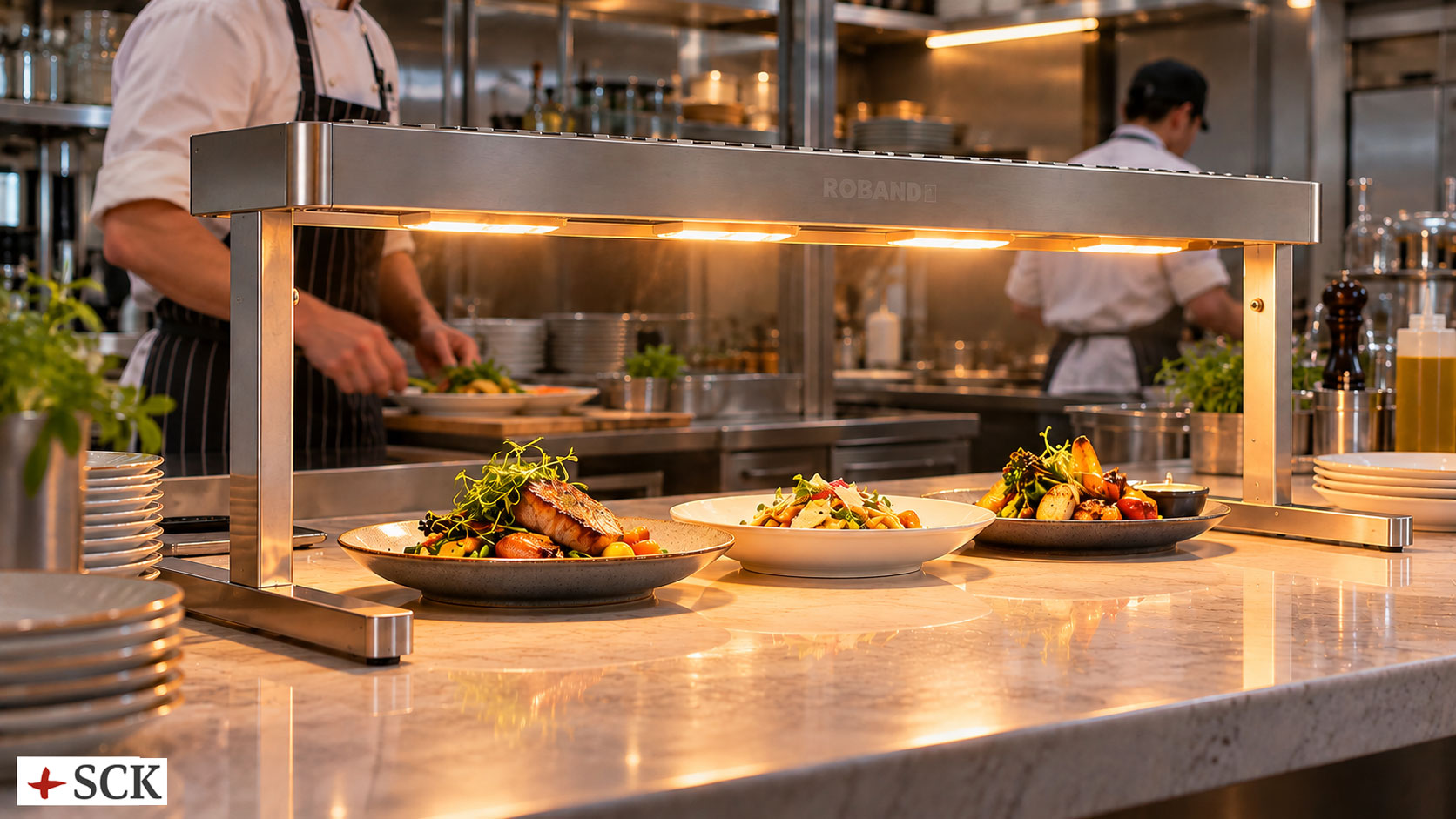
Commercial food heat lamps are essential in many professional kitchens where food presentation, serving temperature and timing directly influence customer satisfaction. Whether meals are waiting at a busy restaurant pass, plated dishes are being prepared for table service, or food is being presented at a catering station, reliable overhead heating can help maintain warmth during short service delays.
However, not every commercial food heat lamp performs the same way. Heating technology, wattage, coverage area, mounting arrangements and service requirements all influence which model is suitable for a particular kitchen.
For Australian hospitality operators, the challenge is finding equipment that provides sufficient warmth without unnecessarily drying out food, increasing operating costs or disrupting kitchen workflow.
The new Roband Compact Strip Heat Lamp range offers two distinct options: the SQ quartz series, which provides heat and light, and the SE infrared element series, designed for heat-only applications with adjustable heating output.
Available in multiple lengths and contemporary finishes, these Australian-made heat lamps provide practical solutions for restaurants, cafés, hotels, pubs, clubs and commercial catering operations.
This guide explores how commercial food heat lamps work, what distinguishes the new Roband range and how to choose the right heating solution for your business.
What Is a Commercial Food Heat Lamp and How Does It Work?
A commercial food heat lamp is an overhead heating appliance designed to help maintain the temperature of prepared food during the final stages of kitchen service.
Unlike cooking appliances, which raise food to its required cooking temperature, heat lamps deliver radiant energy towards food positioned beneath them. This helps reduce heat loss while meals wait to be collected, plated or delivered to customers.
In a restaurant, for example, several dishes may need to leave the kitchen together. A steak could be ready before its accompanying sides, while another plate is waiting for a final garnish.
Without suitable temperature management, completed meals may cool before reaching the dining area.
An overhead heat lamp provides a dedicated warming zone where staff can coordinate service while keeping valuable benchtop space available.
Commercial food heat lamps are commonly installed above restaurant passes, plating stations, takeaway collection counters and foodservice areas.
They are particularly useful for short holding periods, although their suitability for food safety purposes must be assessed separately.
For operators exploring suitable equipment, Sydney Commercial Kitchens offers a selection of Roband commercial heat lamps designed for professional foodservice applications.
What Makes the New Roband Compact Strip Heat Lamps Different?
Roband has introduced an updated generation of Compact Strip Heat Lamps designed to combine reliable overhead heating with a streamlined appearance suitable for modern commercial kitchens.
According to the manufacturer's specification sheet, the updated range incorporates a precision-engineered reflector that delivers approximately 6% more heat compared with the previous design.
This improvement is intended to enhance heating performance, although actual food temperatures will still depend on installation conditions, positioning and operating practices.
The updated range also includes improved cable management, protective guards, accessible controls and a simplified mounting system.
Both quartz and infrared element models are available in natural aluminium or black finishes, allowing operators to select equipment that complements their kitchen design.
This can be particularly useful in open kitchens where food preparation and service equipment remain visible to customers.
The range is divided into two main categories.
Roband SQ Quartz Heat Lamps
The SQ series uses quartz lamps to provide both radiant heat and visible illumination.
These models are particularly useful where operators want to maintain food warmth while improving visibility and presentation at the service pass.
The range includes six nominal lengths from 450 mm to 2100 mm, with power ratings ranging from 350 W to 1750 W.
Roband SE Infrared Element Heat Lamps
The SE series uses infrared heating elements to deliver heat without additional illumination.
These models are suitable for kitchens where existing lighting is sufficient or where operators prefer separate control over heating and lighting.
The SE range includes four nominal lengths from 900 mm to 1800 mm, with power ratings between 900 W and 1800 W.
Unlike the SQ range, the SE models incorporate variable heat control, allowing operators to adjust heating output according to their service requirements.
Both ranges are supplied with a switch, plug, cord and mounting brackets, supporting flexible installation arrangements subject to the manufacturer's instructions.
What Is the Difference Between Quartz and Infrared Food Heat Lamps?
Choosing between quartz and infrared element heating is one of the most important decisions when selecting a commercial food heat lamp.
Although both technologies provide radiant heat, their operating characteristics differ.
Quartz Heat Lamps: Warming and Illumination
Quartz heat lamps provide heat together with visible light, making them useful in kitchens where food presentation and visibility are important.
For example, a restaurant with an open kitchen may benefit from illuminated plating areas where staff can clearly inspect dishes before service.
The Roband SQ range uses multiple quartz lamps depending on model length.
The SQ450 contains one 350 W lamp, while the larger SQ2100 incorporates five lamps with a combined power rating of 1750 W.
These models may suit restaurant passes, plating counters, casual dining kitchens and other locations where meals remain visible before collection.
Infrared Element Heat Lamps: Heat Without Additional Lighting
The Roband SE range provides overhead radiant heat without the additional illumination associated with quartz lamps.
This can be useful in kitchens where separate lighting systems are already installed or where operators want to avoid adding more visible light to the service area.
A notable advantage of the SE series is variable heat control.
This allows kitchen staff to adjust heating output to suit operational conditions rather than relying on a fixed heating level.
For example, a busy restaurant may require different heating intensity during peak service compared with quieter periods.
However, adjusting heating output should not replace temperature monitoring or appropriate food safety procedures.
Which Option Should You Choose?
Quartz models are worth considering when both heat and illumination are desirable.
Infrared element models may be more appropriate when heat-only operation and adjustable output are priorities.
Neither technology is automatically superior. The most suitable option depends on food types, service duration, kitchen lighting, installation requirements and operational preferences.
Which Roband Commercial Food Heat Lamp Size Is Best for Your Kitchen?
Selecting the correct heat lamp length is important because the unit must provide suitable coverage across the intended service area.
A compact café pass may only require a short heating unit, while a larger restaurant or hotel kitchen may benefit from a longer model covering several plating positions.
The new Roband range offers multiple configurations.
Roband SQ Quartz Models
The SQ450 and SQ450B are 450 mm models rated at 350 W, incorporating one quartz lamp.
The SQ900 and SQ900B measure 900 mm and provide 700 W through two quartz lamps.
For medium-sized service areas, the SQ1200 and SQ1200B offer 1050 W through three lamps, while the SQ1500 and SQ1500B provide 1400 W through four lamps.
Larger kitchens can consider the SQ1800 and SQ1800B, which provide 1400 W across four lamps, or the SQ2100 and SQ2100B, which use five lamps with a combined rating of 1750 W.
Roband SE Infrared Element Models
The SE900 and SE900B are 900 mm units rated at 900 W.
The SE1200 and SE1200B provide 1200 W across a nominal 1200 mm length.
For wider service passes, the SE1500 and SE1500B offer 1500 W, while the SE1800 and SE1800B provide 1800 W.
Each SE model incorporates one infrared heating element and variable heat control.
The letter B identifies the black-finish version of each model.
When selecting a model, operators should consider the number of plates normally waiting at the pass, the available bench width and the area requiring heat coverage.
It is also important to distinguish between nominal product length and overall installed dimensions.
For example, Roband's dimensional drawings show that a nominal 900 mm unit may have an overall length of 950 mm under one mounting arrangement.
Confirming the complete installation footprint before ordering can help avoid clearance problems, particularly when fitting heat lamps beneath existing shelving or within custom-built kitchen passes.
How Can Commercial Food Heat Lamps Improve Kitchen Workflow?
A commercial food heat lamp can help improve kitchen efficiency by providing a dedicated area where completed dishes remain warm while staff coordinate service.
Consider a busy restaurant during dinner service.
The grill section prepares steaks, the fryer section handles accompanying sides, and the plating team adds sauces and garnishes before meals leave the kitchen.
These components may not finish cooking at exactly the same time.
A properly managed heated pass helps reduce temperature loss while the kitchen completes the order.
This is particularly valuable when several meals must be delivered together.
Overhead heat lamps also leave the work surface available for plates, trays and other service equipment, unlike some countertop warming appliances that occupy preparation space.
In hotels and function venues, a heated pass may help staff manage multiple plated meals during coordinated service periods.
However, heat lamps should support efficient workflow rather than compensate for unnecessary delays.
The objective remains to deliver freshly prepared food to customers as quickly as practical.
Can Commercial Food Heat Lamps Maintain Safe Food Temperatures?
Food safety is an essential consideration when selecting any commercial food warming equipment.
Under Australian food safety requirements, potentially hazardous food generally needs to be maintained at 60°C or above during hot holding, unless an applicable alternative time-and-temperature procedure is followed.
A commercial heat lamp does not automatically guarantee that food will remain above this temperature.
Its effectiveness depends on several factors, including the initial food temperature, heating output, mounting position, food quantity, ambient conditions and holding duration.
For this reason, operators should use an appropriate food thermometer to verify temperatures rather than relying on how warm the food surface or plate feels.
Heat lamps are also not intended to replace cooking or reheating equipment.
Food requiring reheating must be brought to an appropriate safe temperature using suitable equipment before entering a hot-holding process.
For extended holding periods, dedicated heated food displays, bain-maries or other temperature-controlled equipment may be more suitable.
Operators should follow their food safety program and relevant guidance from Food Standards Australia New Zealand.
Can Heat Lamps Dry Out Food or Affect Presentation?
Yes. Excessive radiant heat or prolonged exposure can affect the moisture, texture and overall quality of prepared food.
Foods such as grilled meat, seafood, roasted vegetables and plated dishes containing sauces may lose moisture when exposed to heat for too long.
Delicate ingredients can be particularly sensitive to extended holding.
The purpose of a commercial food heat lamp is not to apply the maximum possible heat. It is to provide suitable warmth during the intended service period while maintaining food quality.
This is one reason adjustable heating output may be useful.
The Roband SE range allows operators to vary heating intensity, providing greater flexibility when handling different foods or changing service conditions.
However, even with adjustable heating, operators should minimise unnecessary holding time.
Correct lamp positioning, appropriate heating coverage and efficient kitchen communication are equally important.
A well-managed service pass should help meals reach customers promptly rather than encourage food to remain under heat for extended periods.
What Should You Consider Before Installing a Commercial Food Heat Lamp?
Installation planning is important because overhead heat lamps must operate safely around staff, food and surrounding kitchen equipment.
The selected position should provide suitable heating coverage without obstructing preparation activities, ventilation systems or normal kitchen movement.
Roband's updated Compact Strip Heat Lamps include mounting brackets, a power cord, plug and accessible controls.
The manufacturer also identifies options for independent operation or centralised wiring, subject to appropriate electrical installation requirements.
Operators should consider available mounting space, power supply, surrounding materials, cleaning access and the manufacturer's required clearances.
Mounting height is particularly important because it influences heating performance and the amount of space available beneath the unit.
Roband's specification sheet provides mounting-hole dimensions and reversible bracket arrangements to assist with installation planning.
For kitchens where a permanently mounted heat lamp is not practical, compatible portable stands may offer an alternative.
Sydney Commercial Kitchens also supplies Roband heat lamp stands for suitable configurations.
These stands can be useful in selected catering, service pass and food presentation applications where flexibility is required.
The manufacturer's documentation identifies compatibility with portable heat lamp stand configurations in 900 mm and 1200 mm lengths.
Operators should confirm the exact stand and heat lamp combination before purchasing.
Always follow the manufacturer's installation instructions, including required clearances, electrical specifications and mounting arrangements.
Are Commercial Food Heat Lamps Expensive to Operate?
Electricity consumption depends primarily on the unit's rated power, operating time and heating controls.
For example, a 700 W heat lamp operating continuously at full rated output for four hours would consume approximately 2.8 kWh.
A 1500 W unit operating at full rated output for the same period would consume approximately 6 kWh.
Actual consumption may vary depending on operating conditions and control settings.
Although lower-wattage equipment generally uses less electricity at full output, it is not necessarily the most suitable choice for every kitchen.
A wider restaurant pass may require greater heating coverage, while a compact service counter may operate effectively with a smaller unit.
The Roband SE range includes variable heat control, which may help operators reduce unnecessary heating output when full power is not required.
Good operating practices also contribute to energy management.
Switching equipment off when not needed, avoiding unnecessarily long holding periods and selecting appropriately sized units can help reduce avoidable electricity consumption.
The most practical approach is to choose equipment that meets service requirements without excessive heating capacity.
Which Commercial Kitchens Benefit Most from Roband Heat Lamps?
Commercial food heat lamps are used across a wide range of hospitality environments, but the ideal configuration depends on how each business prepares and serves food.
Restaurants and Hotel Kitchens
Restaurants often need to coordinate several dishes before an order leaves the kitchen.
A Roband SQ quartz heat lamp may suit a visible plating pass where additional illumination is useful.
Larger models can be considered for wider service counters, provided the selected unit offers appropriate coverage and meets installation requirements.
Cafés and Casual Dining Venues
Cafés serving breakfast, lunch and casual meals may benefit from compact overhead heating during short delays between preparation and collection.
Smaller Roband models may be appropriate where benchtop space is limited and the volume of plated meals is relatively modest.
Pubs and Clubs
High-volume foodservice operations frequently manage multiple orders during busy lunch and dinner periods.
A longer strip heat lamp can provide overhead heating across a wider pass, helping staff coordinate meal collection without occupying additional countertop space.
Catering and Function Venues
Catering businesses may require more flexible service arrangements depending on the event or venue.
Compatible portable heat lamp stands can provide useful configuration options, although operators must consider stability, electrical safety and appropriate food temperature management.
Buffet and Self-Service Operations
Overhead heating may complement buffet equipment, particularly where presentation and short service intervals are important.
However, heat lamps should not be assumed to maintain safe food temperatures independently.
For extended hot holding, dedicated temperature-controlled equipment may be necessary.
What Common Mistakes Should You Avoid When Buying a Commercial Food Heat Lamp?
One common mistake is choosing a heat lamp based only on its length or wattage.
A longer unit may provide wider coverage, but that does not automatically make it suitable for the food, mounting height or service arrangement.
Another mistake is overlooking the difference between quartz and infrared element heating.
Operators requiring additional illumination may prefer the Roband SQ range, while those seeking heat-only operation with adjustable output may find the SE range more appropriate.
Installation dimensions are another important consideration.
Nominal product length does not always represent the complete installed footprint, particularly when different mounting bracket configurations are available.
Some buyers also expect heat lamps to maintain food indefinitely without affecting quality.
In practice, prolonged exposure can dry out food, and safe holding temperatures must be verified.
Finally, operators should consider maintenance requirements, cleaning access and the availability of replacement components.
A suitable commercial food heat lamp should integrate naturally into the kitchen's workflow while remaining practical to operate and maintain.
Why Choose Roband Commercial Food Heat Lamps for an Australian Kitchen?
Roband is an Australian manufacturer of commercial foodservice equipment, with products designed for professional hospitality environments.
Its new Compact Strip Heat Lamp range provides multiple lengths, two heating technologies and a choice of natural aluminium or black finishes.
The SQ quartz models combine heating with illumination, while the SE infrared element models provide heat-only operation with adjustable output.
The updated reflector, protective guards, improved cable management and simplified mounting arrangements are additional features worth considering when upgrading an existing kitchen pass.
The manufacturer's specification sheet identifies a one-year warranty, subject to current warranty terms.
For businesses replacing older heating equipment, comparing the new Roband models against existing mounting dimensions, power requirements and service needs can help avoid unnecessary installation complications.
The range may also suit new commercial kitchen projects where overhead heating is being incorporated into the original design.
Where Can You Buy Roband Commercial Food Heat Lamps in Australia?
Selecting a commercial food heat lamp involves more than choosing a model from a product catalogue.
Operators need to consider heating technology, available space, service volume, installation requirements and the types of food being prepared.
Sydney Commercial Kitchens supplies commercial kitchen equipment to Australian hospitality businesses, including restaurants, cafés, hotels, pubs, clubs, caterers and institutional foodservice operations.
Customers can explore the Roband heat lamp range to compare available food warming equipment or browse Roband heat lamp stands when a compatible portable arrangement is required.
For businesses planning a new kitchen or upgrading an existing service pass, Sydney Commercial Kitchens can help identify suitable equipment options based on operational requirements.
The goal is to select a heating solution that supports food quality, efficient service and practical day-to-day operation.
Frequently Asked Questions About Commercial Food Heat Lamps
1. What is the best commercial food heat lamp for a restaurant?
The best commercial food heat lamp depends on the restaurant's service volume, pass dimensions, food types and heating requirements. Roband SQ quartz models suit applications requiring heat and illumination, while SE infrared element models provide heat-only operation with adjustable output.
2. What is the difference between Roband SQ and SE heat lamps?
Roband SQ models use quartz lamps to provide heat and visible illumination. SE models use infrared heating elements to provide heat without additional lighting and include variable heat control. Both ranges are available in natural aluminium and black finishes.
3. Can commercial heat lamps keep food at 60°C?
Commercial heat lamps can help maintain food warmth, but they do not automatically guarantee a food temperature of 60°C or above. Operators must verify food temperatures and ensure their hot-holding procedures comply with applicable Australian food safety requirements.
4. How long can food stay under a commercial heat lamp?
There is no universal safe holding time based solely on the presence of a heat lamp. Safe holding depends on food temperature, time, food type and applicable food safety controls. Food quality may also deteriorate during extended exposure.
5. Are Roband Compact Strip Heat Lamps available in black?
Yes. The updated Roband SQ and SE ranges are available in natural aluminium and black finishes. Models with the B suffix identify the black versions.
6. Can Roband heat lamps be installed on portable stands?
The new Roband Compact Strip Heat Lamp range is designed to suit compatible Roband portable heat lamp stands in 900 mm and 1200 mm configurations. Operators should confirm compatibility and installation requirements before purchasing.
7. Are infrared heat lamps better than quartz heat lamps?
Neither type is universally better. Quartz lamps provide heat and visible illumination, making them useful for food presentation. Infrared element models provide heat without additional lighting, and the Roband SE range offers adjustable heating output.
8. Do commercial food heat lamps use a lot of electricity?
Electricity consumption depends on wattage and operating time. For example, a 900 W heat lamp operating continuously at full rated output for five hours consumes approximately 4.5 kWh. Choosing an appropriately sized unit and managing operating hours can help control energy costs.
Final Thoughts: Choosing the Right Commercial Food Heat Lamp
A commercial food heat lamp may appear to be a relatively simple piece of equipment, but its contribution to food presentation, temperature management and kitchen workflow can be significant.
The right model should provide appropriate heating coverage, suit the available installation space and support the way meals move through the kitchen.
Roband's new Compact Strip Heat Lamp range offers Australian hospitality operators a choice between quartz heating with illumination and infrared element heating with adjustable output.
With models ranging from compact 450 mm units to larger 2100 mm configurations, the range provides options for different commercial foodservice environments.
Before purchasing, consider the size of your service pass, the types of meals being prepared, expected holding periods and electrical and mounting requirements.
For professional guidance, explore the Roband commercial food heat lamps available through Sydney Commercial Kitchens or browse compatible heat lamp stands for your service setup.
Need help selecting the right Roband heat lamp for your commercial kitchen? Contact Sydney Commercial Kitchens today for product advice and equipment options suited to your business.
Make your business our next satisfied client
If you are looking to buy equipment for your cafe or restaurant at the best price, then let us do the hard work and source the right product for your restaurant, cafe, takeaway or commercial kitchen.
Our goal at SCK is to sell you products that add value to your business.
We power your kitchen!
Sydney Commercial Kitchenshttps://uploads.prod01.sydney.platformos.com/instances/647/assets/modules/homepage/images/sck.svg?updated=1793097253